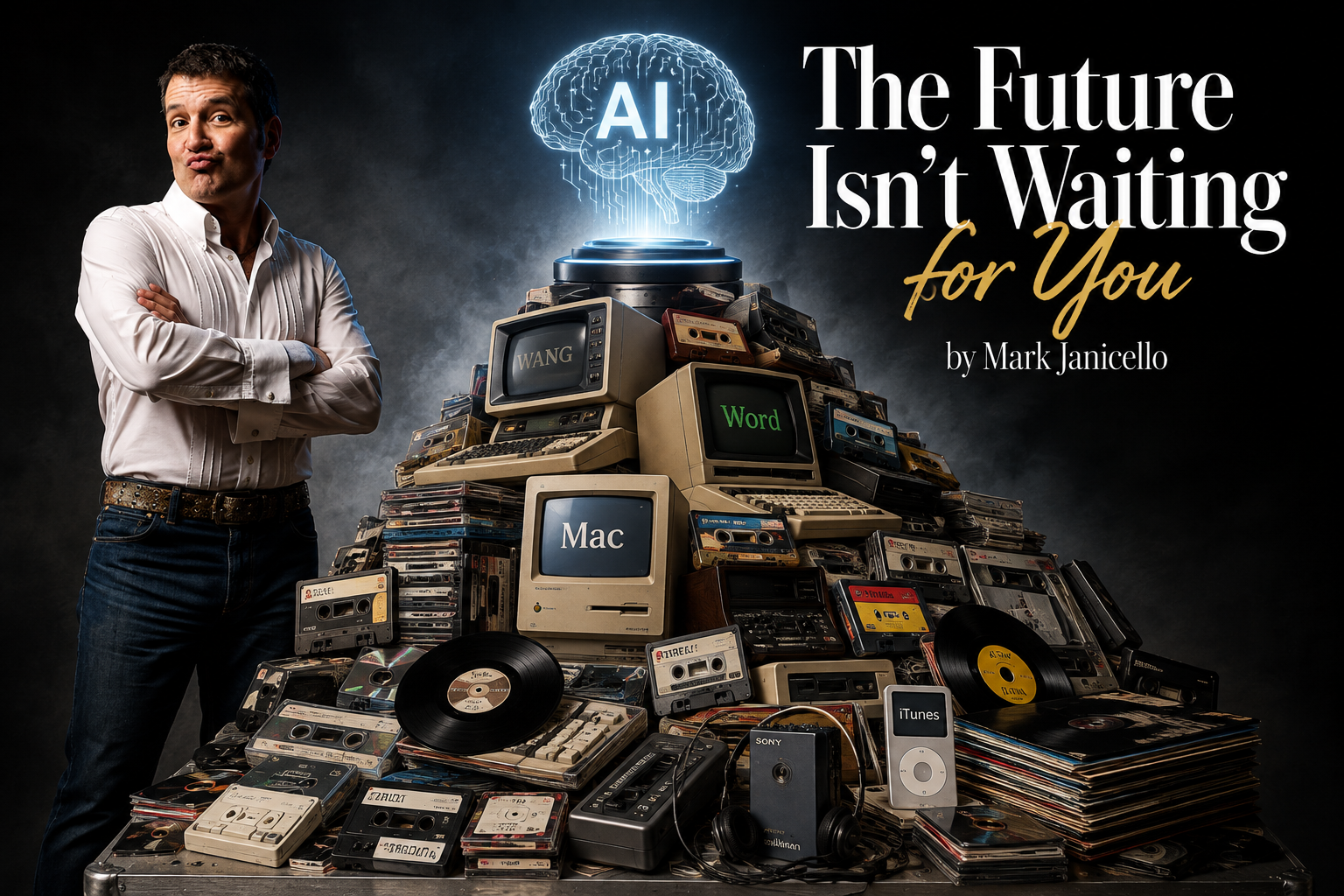
There is a funny thing about technology. We tend to think of it as something that happens to us. One day there is a new computer. Then there is a new operating system. Then the way we record music changes. Then the way we communicate changes. Then suddenly everyone is talking about artificial intelligence, algorithms, SEO, ChatGPT and something called "AI search." And those of us who aren't computer scientists can be forgiven for occasionally wondering: Did I miss something? When did this all happen?
I've been asking myself that question recently. For quite some time now, I've been studying Search Engine Optimisation, artificial intelligence and the rapidly changing ways in which people discover information online. I've been using ChatGPT and Google's AI tools to analyse my own website and help me understand how I can make it more visible — not only to traditional search engines, but to the new generation of AI-powered search systems as well.
I have to admit that it has been a slow and sometimes tedious education. There are an extraordinary number of new technical terms to learn: JSON, schema markup, structured data, entity recognition, semantic search, crawling, indexing, metadata, generative AI and large language models. At times, I feel as though I'm a foreign language student dropped into a doctoral program at MIT. However, the more I learn, the more I realise something that I have proven to be true throughout my entire career: technology isn't the enemy of creativity. Ignorance of technology can be.
New York Is a Tough Place to Be an Artist
Long before I was thinking about artificial intelligence, I was simply trying to make a living. When I began my career in New York City, I was 21 years old, and like every young artist fresh out of university, I went to the Mecca of theatre, NYC, looking for my "big break" to get me on Broadway. It never occurred to me that I was one of tens of thousands looking for the exact same thing at the exact same time. Naturally, acting and singing jobs were almost impossible to come by. In my first year in NYC, I went to 700 auditions. I auditioned for EVERYTHING and ANYTHING, and was hired for almost NOTHING.
New York is expensive. Rents are astronomical. I shared an apartment with four other young actors like myself — on a side note, of my four housemates, I'm the only one still in the business. Like most young performers, I needed another way to pay the bills while I pursued the career I actually wanted.
I learned typing in the 9th grade. I HATED that class, but because I was a pianist, I had incredible dexterity and was an extremely fast typist. So, to make money, I became a typist in a law office in 1985. Technology soon began to change the nature of my job. The typewriter was being replaced by the computer. When I found out that computer-savvy people earned more money, I enrolled in a course to work on computers and learned how to use a Wang computer, one of the systems then being introduced into offices in New York. I learned the difference between traditional typing and the new world of word processing.
That decision changed my career and my life. I went from being a typist to becoming a word processor. Eventually, I moved on and studied Microsoft Word, Windows, Macintosh and Apple technology. None of these things had anything to do with singing or acting, and yet they had everything to do with my ability to survive NYC until I could become the artist I dreamed of being.
The more I understood computers, the more valuable I became in the workplace. My income increased dramatically. I was able to support myself and my family while still going to auditions and studying my craft. Singing and acting lessons are not cheap. Dance classes aren't hugely expensive, but when you add them to the other things I was studying, I needed a HUGE cash flow to make my life as an artist work in the Big Apple. My "computer income" financed the artistic career I was trying to build.
The computer wasn't taking me away from my art. The computer was helping me pay for my art.
That distinction has stayed with me.
I Was Online Before Most Performers Thought They Needed To Be
In 1998, I created my very first personal website. At the time, almost nobody I knew had one. There was no Instagram, no Facebook, no YouTube and no TikTok. Google was still in its infancy. Most performers were still handing out hard copies of photographs, résumés and business cards and hoping that somebody important would keep them.
I understood that the internet was going to change that. I didn't necessarily understand how it was going to change it, and I certainly couldn't have predicted what the internet would become. But I knew that something important was happening, and I wanted to be there.
That has become something of a recurring pattern in my life. I don't always understand a new technology immediately, but I want to understand it. Honestly, I didn't need to fully understand HOW a technology works to utilise it. I'm not a programmer; I'm an end user. But I wanted to understand enough to know how I could make my life and work easier by using the new technologies.
From Cassettes to Streaming
The same thing happened with music. I watched the industry move from analogue to digital recording, from cassettes to CDs, from CDs to MP3s, from physical music to downloads and from downloads to streaming.
Every transition created anxiety. Every change was blown up into "end of the industry" headlines. Many of my colleagues fought every change, every step of the way. Needless to say, most of them are no longer in the industry. People were terrified that the new technologies would destroy the old business models. Sometimes they did, but they also created opportunities that hadn't existed before.
As a performer, my job wasn't to stop technological change. My job was to figure out how to use it. I have ALWAYS taken that job very seriously, and it has enriched my life and my creative endeavours exponentially.
Today, I have recorded music available across multiple platforms. My performances can be seen by people anywhere in the world. A singer who once needed a record company, a television appearance or a major concert promoter to reach a large audience can now potentially reach millions of people from a laptop.
That doesn't mean technology has made becoming a successful performer any easier. Quite the opposite. It has made the competition enormous, but it has also lowered the barriers to entry, and that is an important distinction.
Now Comes Artificial Intelligence
Which brings me to where I am today.
For the first time in my career, I have started actively creating with AI-assisted tools. I have used ChatGPT to do first drafts of graphic designs for promotional materials. I then "fine-tune" the results, but this has saved me oodles of time. To be honest, I find AI both fascinating and slightly terrifying, because some of its abilities are astoundingly good.
A machine can generate an image. It can analyse text. It can suggest ideas. It can help write, organise, research and edit — but it doesn't have a childhood. It doesn't have memories. It doesn't know what heartache was behind the creation of a lyric or a scene in a play. It doesn't know what it feels like to stand backstage five minutes before walking onto a stage in front of 2,000 people with butterflies in your stomach. It hasn't experienced failure. It hasn't fallen in love. It hasn't been rejected for a job. It hasn't performed in 53 countries. It hasn't spent decades trying to understand what an audience wants from a performer or a performance, and it isn't able to pivot on the spot to make a live performance work.
That is human. That is emotional. That is instinct, and that will always be irreplaceable.
My life experiences are mine, and they are precisely what I bring to the technology that I use to help me work more efficiently and effectively. AI doesn't replace my experience. My experience and understanding amplify what AI can do for me and my creations.
That is how I'm beginning to look at it.
What Artists Can Learn From AI
If AI makes a mistake, it doesn't become defensive. It listens to criticism and adjusts its output. Let me repeat that. If AI makes a mistake, it listens to criticism and adjusts its output. There are no justifications. There are no meltdowns. There are no tears. AI listens, considers and looks for ways to make the end product what is needed and wanted.
Actors, singers, painters, dancers... we are all in the business of providing something that fulfils both our need to communicate in a specific, unique way and our audiences' need to witness, purchase or consume that communication in one form or another. We serve both our art forms and our audiences, whether live or virtual.
In a rehearsal room, a director, a conductor, a choreographer or designer may say, "I'm not sure about that. Let's try this..." We, as artists, have to become as open to artistic direction and discussion as AI is.
Believe me, I'm as guilty as anyone else of sometimes being stubbornly "fixated" on ONE way of doing something artistic. However, through my work with AI, I've realised that there are end products and creations available to me that I never even considered possible.
It has opened my eyes to my own sometimes limited view of what I can do, or what can be done. This has been a revelation, and an area in my artistic life where I am trying, more and more, to emulate AI's openness to "adjustment."
We Have Seen This Movie Before
The irony is that none of this is actually new. The technology is new. The pattern isn't.
When I learned the Wang computer, I wasn't abandoning my artistic ambitions. I was acquiring another skill that made those ambitions more financially sustainable. When I moved from typing to word processing, I wasn't becoming less creative. I was becoming more employable. When I built a website in 1998, I wasn't abandoning traditional publicity. I was giving myself another way to be discovered. When I embraced digital recording, CDs, MP3s and streaming, I wasn't rejecting the music business. I was learning how the music business was changing.
And now, with AI, I'm doing exactly the same thing. I'm learning.
You Don't Have to Love the Technology
I think this is where many people get stuck. They believe they have to become technology enthusiasts. You don't.
I don't particularly want to spend my life learning programming. I don't want to become a software engineer. I want to sing. I want to act. I want to create. I want to write. I want to perform.
But I also understand that if technology is changing the way people discover, consume and purchase creative work, then I need to understand enough about that technology to participate in the new economy.
You don't have to become an expert. But you do have to become literate. There is a difference.
Artists of the Future Will Need to Be More Than Artists
This may be one of the most important lessons I've learned during my career.
Being talented is not enough. It never was. We work in the Entertainment BUSINESS. You have to understand the business surrounding the talent. You have to understand marketing. You have to understand publicity. You have to understand branding. You have to understand audiences. You have to understand distribution. And increasingly, you need to understand technology.
The good news is that technology has never been more accessible.
A young performer today can record a song in a bedroom, edit a video on a phone, create artwork with AI-assisted tools, publish internationally, build a website and communicate directly with an audience that could be anywhere on the planet. That's extraordinary.
But there is a warning attached. Having the tools doesn't mean you know how to use them. That still requires learning. And learning requires humility.
I Am Still Learning
At 63, I find that particularly interesting. There is a tendency to think that experience means you have all the answers. It doesn't. I certainly don't. Experience has taught me that whenever you think you've got it all figured out, life pulls the rug out from under you, everything changes, and then you understand how little you actually know about what is coming next.
I've spent more than 35 years working professionally. I've performed in 53 countries. I've worked in opera, musical theatre, cabaret, film, television, concerts and recordings. I've watched entire industries change around me.
I'm still here. I'm still creating. I'm still loving what I do, and at the same time, I am still sitting in front of a computer trying to understand technology. I am trying to learn how an AI search engine decides whether I get "found" for a job or not. I am figuring out how to make AI, computers and end users understand who I am, what I do, and why I'm the person they need for WHICHEVER job.
Honestly? I love it.
It keeps me young. It keeps me fresh. It keeps me curious.
Curiosity supposedly killed the cat, but it sure has helped this cat have nine artistic lives. Curiosity may be one of the most valuable survival skills an artist can have.
Don't Fight the Future
Every generation has its technological dividing line. For my parents' generation, it was perhaps television. For mine, it was computers, digital technology and the internet. For today's performers, it is artificial intelligence. Tomorrow it will be something else.
There will always be people who complain that the new technology isn't as good as the old technology. Sometimes they'll be right. But that isn't really the point. The point is that the technology is coming anyway.
You can stand on the platform and complain about the train, or you can board the train and see where it takes you. As long as I can, I will always board the train. I love an adventure, and technology is just another adventure... at least in my mind.
From typewriters to Wang computers. From word processors to Windows and Apple. From analogue recording to digital. From cassettes to CDs to MP3s to streaming. From my first website in 1998 to SEO and AI today.
The technology keeps changing. The reason I keep learning it is simple. I don't want technology to decide my future for me because, ultimately, the goal hasn't changed.
I still want to create. I still want to perform. I still want to connect with an audience, and I still want the work to lead to opportunities. The tools are different. The world is different. But the objective is exactly the same.
Keep learning. Keep adapting. Keep creating – and never, ever assume that the future is something that happens to somebody else.

Mark Janicello
Award-winning performer, playwright, and voiceover artist with 35+ years of international experience across 53 countries. Author of "Naked in the Spotlight."